
Shrine of Shah Yousaf Gardezi
A Landmark of Faith, Architecture and Multan’s Identity
Shah Yousuf Gardez was an Islamic Sufi saint who came to Multan, (present-day Punjab, Pakistan) in 1088 AD. He is said to have restored the city of Multan, converted many people to the Islamic religion, and performed numerous miracles.[1] He came from Gardez in the present-day Paktia Province of Afghanistan.
Historical Overview
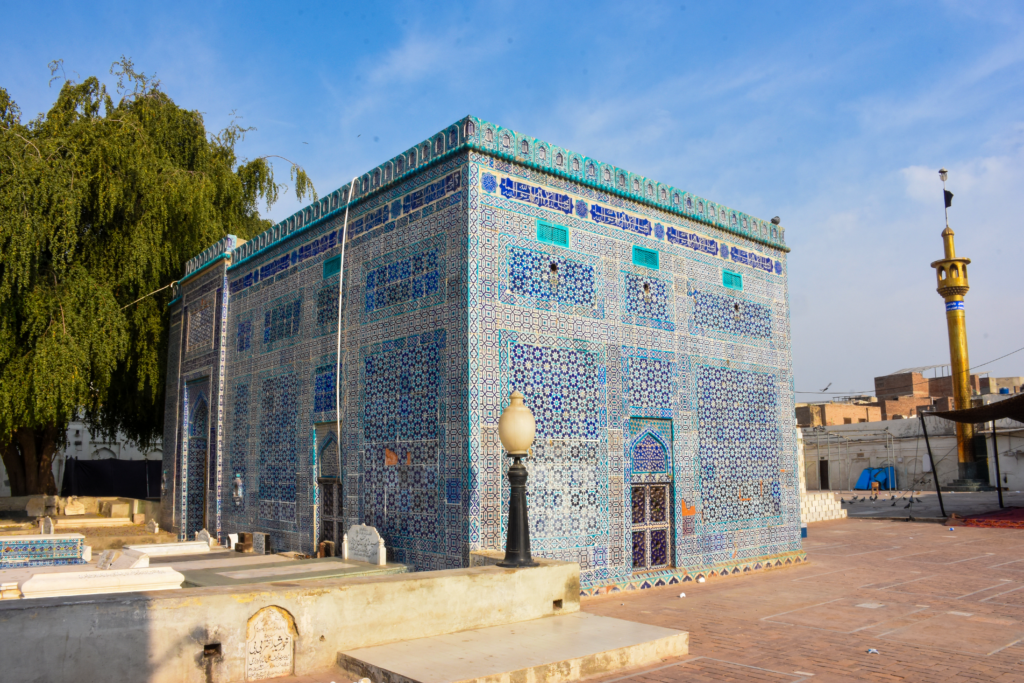
Shah Yousuf Gardezi Tomb (built c. 1152, rebuilt 1548)
Shah Yousuf Gardezi’s Tomb is located about 600 meters southwest of the former fort of Multan. The historical heart of the site is a small cubical building with a flat roof, decorated on all sides with blue and white glazed tiles embellished with floral patterns and aina-kari mirror-work on the interior.
Very little is known about Yousuf Gardezi’s life, other than that he was born in 1058 in Gardez (near present-day Ghazni) and came to Multan during the reign of Bahram-Shah of Ghazna (r. 1117-57), where he helped to spread Islam and repopulate the city. He died in 1136 and was likely buried in a permanent tomb in the subsequent decades. According to Hasan, the present tomb was probably rebuilt in the 16th century as a plaque located on site provides the year 955 AH, corresponding to 1548 (Hasan, p. 50). The architectural historian Kamil Khan Mumtaz suggests that the reconstructed tomb “probably retain the character of the original as it was built in 1152.” (Mumtaz, p. 44). If correct, that suggests that flat-roofed tombs were in use at least a century before domed mausoleums began to make their first appearance in the city with the construction of Bahauddin Zakariya’s tomb.
Flat-roofed tombs were less common in later years in Multan, but they were used with greater frequency in neighboring Uch Sharif with notable examples being the Jalaluddin Bukhari Tomb and Rajan Qattal Tomb.
Spiritual Importance
The shrine continues to welcome devotees and visitors seeking reflection, prayer and connection with Multan’s spiritual heritage. Visitors are encouraged to experience the site with respect and sensitivity.
The Scared Interior
The interior reveals a vast, pillar-less space that emphasizes the spiritual scale of the monument. At its heart lies the carved wooden mihrab, widely considered the earliest and finest of its genre in the region.
Surrounding the saint’s sarcophagus are 72 graves of his descendants and devotees, a
symbolic number alluding to the martyrs of the Battle of Karbala.
Spiritual Importance
“The interior woodwork and tile mosaics represent a synthesis of local Multani craftsmanship and Central Asian architectural influences.”
Architecture
Blue Tilework
Decorative blue and turquoise elements connect the monument with the wider artistic traditions of Multan.
MONUMENTAL FORM
The shrine’s strong geometric massing gives it a distinctive presence within Multan’s skyline.
DOME STRUCTURE
Its dome creates a powerful visual profile visible from across the historic precinct.
Visitor Guidelines
Dress modestly and respectfully
Follow instructions from site custodians
Remove footwear where requested
Avoid disturbing worshippers
Ask before photographing people
Keep noise to a minimum
Explore the Gallery
View architectural details, tile patterns, historic views, the surrounding precinct and changing light across the monument.
Book a heritage walk
Guided walks cross historic gates, sacred shrines, and narrow bazaars. Stories hide in the walls and wait in the streets.
OPERATIONAL SCOPE
What We Do
Promote awareness of Multan’s heritage
Support conservation and documentation
Develop visitor information and heritage routes
Highlight traditional crafts and living culture
Encourage responsible cultural tourism
Share research and educational material
Promote community participation
Preserve stories, memories and cultural knowledge
Our Impact
By connecting cultural heritage with tourism, research, education and community
engagement, Walled City Multan aims to strengthen public appreciation for the historic city and encourage its long-term protection.