
ghanta ghar multan
Multan Fort
Historical Overview
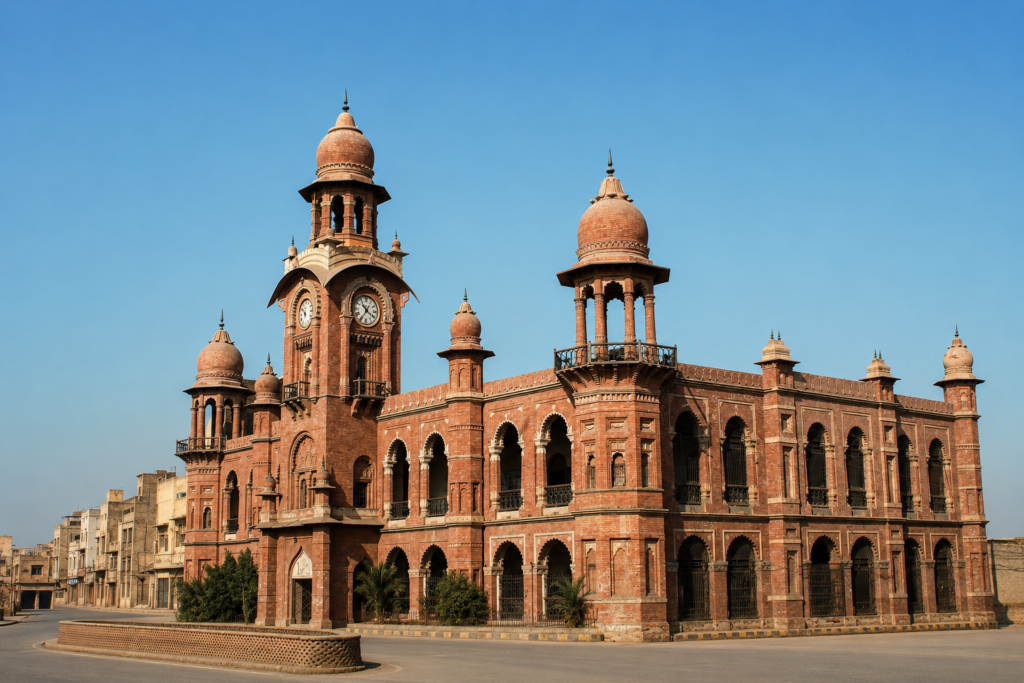
Ghanta Ghar or Clock Tower of Multan was built in 1884 in British India. After passing the municipal act of 1883 British needed offices to run the city. They started constructing Ghanta Ghar in Multan on 12 February 1884 and it took 4 years to completely build this building. It was constructed over the ruins of Haveli of Ahmad Khan Sadozai which was completely destroyed during Siege of Multan. The hall and building were named ‘Ripon Hall and Ripon Building’ after the name of Ripon, viceroy of India at that time. And clock tower was named Northbrook Tower after the name of Northbrook, a former Viceroy of India (1872–3).
This building was completed, opened and offices shifted in 1888. Hall was named ‘Jinnah Hall’ after the independence of Pakistan in 1947 and is used for office meetings, cultural programs, and is open to the public. With the passage of time, this building became insufficient for offices and a small hall was also insufficient for meetings, so offices were shifted from here. Now it is said that plan for the future is to change this historic building into a museum.
Clock
On 27 October 2011, three clocks of Ghanta Ghar were repaired and started again showing the time of PST which is +5GMT. This effort was done by a watch company Rado Watchmaker. The machinery and needles of the clocks were changed while the clock’s main dial was unchanged. It runs on solar energy. The clock had stopped working in 1985.
Visitor Guidelines
Dress modestly and respectfully
Follow instructions from site custodians
Remove footwear where requested
Avoid disturbing worshippers
Ask before photographing people
Keep noise to a minimum
Explore the Gallery
View architectural details, tile patterns, historic views, the surrounding precinct and changing light across the monument.
Book a heritage walk
Guided walks cross historic gates, sacred shrines, and narrow bazaars. Stories hide in the walls and wait in the streets.
OPERATIONAL SCOPE
What We Do
Promote awareness of Multan’s heritage
Support conservation and documentation
Develop visitor information and heritage routes
Highlight traditional crafts and living culture
Encourage responsible cultural tourism
Share research and educational material
Promote community participation
Preserve stories, memories and cultural knowledge
Our Impact
By connecting cultural heritage with tourism, research, education and community
engagement, Walled City Multan aims to strengthen public appreciation for the historic city and encourage its long-term protection.