
Qila Kohna Qasim Bagh
Multan Fort
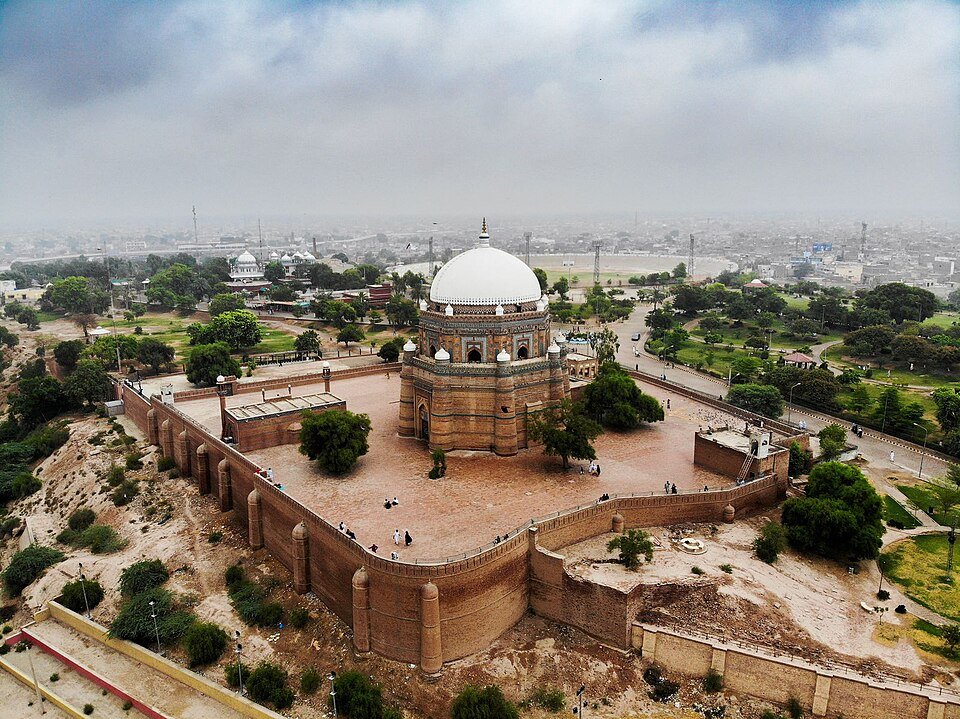
Historical Overview
The Multan Fort was a historic fort in the city of Multan, Punjab, Pakistan. It was built on a hillock separated from the city by the Ravi River. The fort was destroyed in 1849 by British forces during the Second Anglo-Sikh War. The storming of the Multan Fort by the British troops on 2 January 1849
The walls of the fort were built by the Mughal prince Murad Bakhsh in the 17th century. The fort was notable for both its effectiveness as a defence installation and for its architecture. The famed Multan Sun Temple was located within the fort premises. Contemporary reports put the walls of the fort at 40 to 70 feet (21 m) high and 6,800 feet (2 km) in circumference. The fort had 46 bastions which included two flanking towers at each of the four gates (the De, Sikki, Hareri and Khizri Gates). A ditch 25 feet (7.6 m) deep and 40 feet (12 m) wide and an 18-foot (5.5 m) glacis protected the fort from intruders. The 1st Bombay European Fusiliers storming the Breach at the Koonee Boorg, 2 January 1849
Within the fort stood a citadel flanked by 30 towers, enclosing a Hindu temple and a governor’s palace. The citadel was severely damaged by the battering it got from the guns during the siege in 1818.
Multan Sun Temple
The Sun Temple of Multan was a temple dedicated to Surya, the Hindu Sun-God, in the city of Multan in modern Pakistan. The exact location of the temple remains unknown.
The temple commanded significant fame in the subcontinent as a place of pilgrimage and wealth under Hindu as well as Muslim rule and was supposedly destroyed in the late tenth century CE. It appears to have been reconstructed, before being purportedly obliterated by the Mughal Emperor Aurangzeb at some point after 1666.
Visitor Guidelines
Dress modestly and respectfully
Follow instructions from site custodians
Remove footwear where requested
Avoid disturbing worshippers
Ask before photographing people
Keep noise to a minimum
Explore the Gallery
View architectural details, tile patterns, historic views, the surrounding precinct and changing light across the monument.
Book a heritage walk
Guided walks cross historic gates, sacred shrines, and narrow bazaars. Stories hide in the walls and wait in the streets.
OPERATIONAL SCOPE
What We Do
Promote awareness of Multan’s heritage
Support conservation and documentation
Develop visitor information and heritage routes
Highlight traditional crafts and living culture
Encourage responsible cultural tourism
Share research and educational material
Promote community participation
Preserve stories, memories and cultural knowledge
Our Impact
By connecting cultural heritage with tourism, research, education and community
engagement, Walled City Multan aims to strengthen public appreciation for the historic city and encourage its long-term protection.